

What if a film that heals itself still leaves some damage untouched? It can, and that distinction matters when choosing self healing paint protection film for a cherished vehicle. The phrase can suggest more than it delivers: minor surface marks may soften as the film’s top layer responds to warmth, but a cut or deep gouge won’t simply disappear. Nor does a mark on the film, by itself, prove that the paint beneath has been harmed.
Before protecting a valued finish, it helps to know what the film can and cannot do. This guide explains which fine marks self-healing PPF may reduce, how it helps protect against stone chips and everyday wear, and where its limits lie. It also covers how to care for the film and what to look for when a mark appears. With realistic expectations and precision-led installation, you can make a considered choice about protecting your vehicle’s finish.
Key Takeaways
- Self healing paint protection film can soften some minor surface marks, but it doesn’t restore damaged paint or bodywork.
- Heat may help the film’s surface recover from fine marks; deeper cuts and punctures are beyond its self-healing ability.
- A mark on the film doesn’t automatically mean the paint beneath has been damaged. Look for signs such as a visible cut, tear or puncture.
- Gentle washing and following the film’s care instructions help preserve its appearance.
- Precision installation is an important part of protecting a luxury or exotic vehicle’s finish.
What Is Self-Healing Paint Protection Film, and What Does It Do?
Self-healing paint protection film (PPF) is a protective layer whose surface can recover from some minor marks. The term describes the film’s response, not a vehicle that repairs itself. Under suitable conditions, fine marks in the film may become less visible. It won’t restore damaged paint, reshape bodywork or erase every sign of an impact.
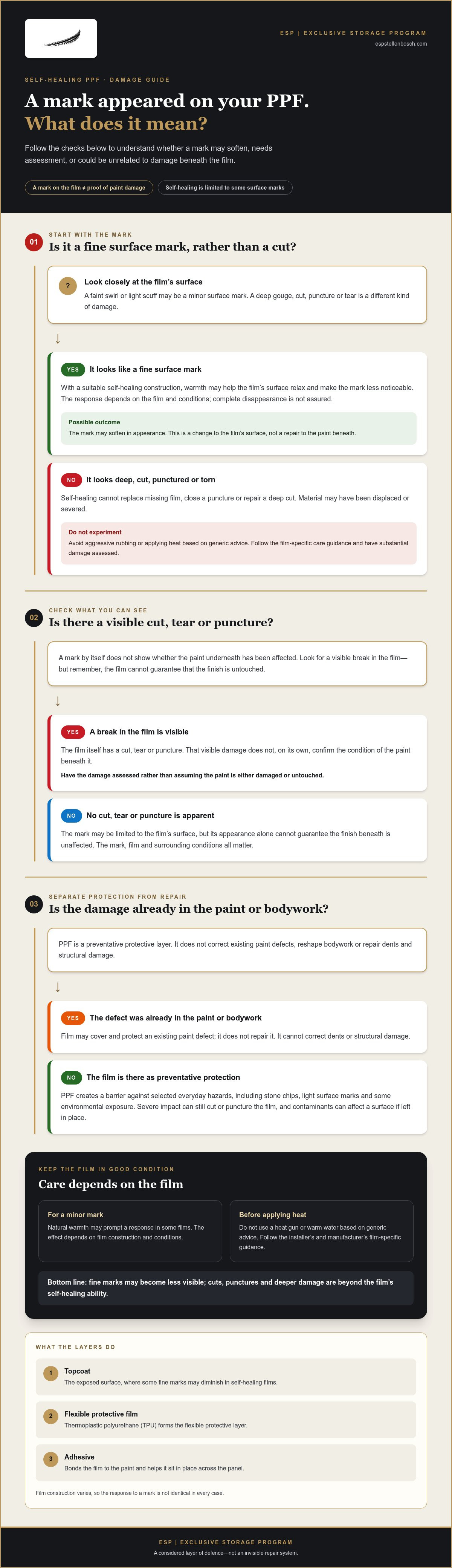
That distinction matters when a mark appears on a protected panel. A faint swirl in the film may soften, while a cut through the material remains. A visible mark doesn’t automatically mean the paint beneath has been affected, but the film can’t guarantee that the finish is untouched either. The outcome depends on the mark, the film and the conditions around it.
What does self-healing mean on a car?
Picture a flexible surface settling back after a light impression. That’s a useful, if simplified, way to think about self-healing: minor marks may diminish as the film’s surface responds to warmth. The recovery can reduce their visibility rather than remove every trace. A deep gouge or torn film is different, because the material itself may have been cut or displaced.
What does paint protection film protect?
PPF creates a barrier between a vehicle’s paint and some hazards encountered in everyday use. Stone chips, light surface marks and environmental exposure can all threaten a carefully maintained finish. A thermoplastic urethane paint protection film is applied to vehicle surfaces for preventative protection, not to correct existing defects.
For example, film on an exposed panel may take the contact from road debris before it reaches the paint. It can also help shield the finish from some environmental contaminants. The protection has limits: a severe impact may puncture or cut the film, and contaminants can still affect a surface if left in place. PPF isn’t a substitute for attentive vehicle care.
- Minor marks: Some fine marks in the film may become less noticeable.
- Existing paint defects: Film covers and protects; it doesn’t repair scratches or chips already in the paint.
- Bodywork damage: A protective layer cannot correct dents or structural damage.
Self healing paint protection film is best understood as a considered layer of defence, not an invisible repair system. Its self-healing behaviour applies only to certain marks on the film itself, while the film can help preserve the finish against selected everyday hazards. Keeping that boundary in mind makes it easier to assess what the film may do for a cherished vehicle, and what it cannot promise.
How Self-Healing PPF Works: Film Layers, Heat and Minor Marks
The self-healing effect belongs to the film’s surface, not to the paint beneath it. PPF is built from layers that work together: an exposed topcoat, a flexible protective film and an adhesive that bonds the material to the vehicle. Construction varies between films, so the response to a mark won’t be identical in every case.
What each film layer contributes
The topcoat is exposed to washing, road grime and light contact. In self-healing paint protection film, it’s where the surface properties that allow some fine marks to diminish may be designed. Beneath it, thermoplastic polyurethane, or TPU, provides a flexible protective layer. The adhesive bonds the film to the paint, helping it sit in place across the panel. Each layer has a distinct role; the self-healing response is not a repair function shared by the entire vehicle.
Research into the mechanisms of self-healing polymer coatings examines how some materials respond to triggers such as heat. That broader science helps explain the principle, but it isn’t a promise that every PPF behaves the same way. Film formulation and the condition of its surface matter.
How heat can help minor marks recover
The process is easiest to picture in sequence. A light scuff or fine swirl affects the film’s exposed surface. With a suitable self-healing construction, warmth may help that surface relax, allowing the mark to become less noticeable. This changes the mark’s appearance; it doesn’t fill a cut or restore paint.
Natural warmth from the environment may prompt a response in some films. Deliberate heating is different: the methods and limits depend on the particular film and its care requirements. Don’t apply a heat gun or warm water based on generic advice. Follow the installer’s and manufacturer’s film-specific guidance instead, since unsuitable treatment could affect the film or its bond.
- A minor mark forms: The surface is lightly disturbed, without a deep cut through the film.
- Warmth affects the surface: The film’s response may be activated, depending on its construction and the conditions.
- The mark may soften: Its visibility can diminish, though complete disappearance isn’t assured.
Severity is central. A fine surface mark is more likely to respond than a deep cut, puncture or tear, where material has been displaced or severed. Heat cannot replace missing film, close a puncture or repair paint damage beneath the layer. If a mark looks substantial, don’t experiment with heat or rub it aggressively. Follow the film-specific care guidance and have the damage assessed.
Understanding these layers also shows why careful application matters. ESP provides precision installation of premium self-healing PPF for luxury and exotic vehicles, with protection intended to help preserve the finish. Explore precision PPF installation as part of considered vehicle care.
Self-Healing PPF: Realistic Limits, Damage Types and Expectations
Self-healing describes a limited response to certain marks on the film’s surface. It doesn’t make PPF scratch-proof or indestructible. A light scuff may become less noticeable, while a sharp impact can cut through the material. When a mark appears, consider its depth and whether the film or paint may be affected instead of assuming it will disappear.
There’s no universal result. Film construction, the severity of the mark and the surrounding conditions all influence whether a surface mark responds. Even when it does, the film may look improved rather than flawless. Treat self-healing as one property of a protective layer, not a promise of invisible or permanent repair.
Which marks may self-healing film reduce?
Fine swirls from washing or a light scuff on the film’s surface may soften. These marks disturb the outer surface without cutting deeply into the protective material. A pronounced scratch is different: if the film is split, gouged or missing, there’s no intact surface to recover in the same way. The film and conditions matter, so appearance alone can’t guarantee the outcome.
What self-healing PPF cannot repair
A cut or puncture can compromise the film, and a severe impact may affect the paint or bodywork beneath it. The film cannot replace missing material, restore a chipped finish or reshape a dent. Significant damage needs a separate assessment, not repeated rubbing or attempts to test whether heat will make it heal.
| What you see | What to expect |
|---|---|
| Fine swirl or light surface scuff on the film | May become less visible, depending on the film and conditions. |
| Deeper cut or gouge | May remain visible; the film could be damaged through its surface. |
| Puncture or tear | Self-healing won’t replace or reconnect film that has been cut through. |
| Damage reaching the paint or bodywork | Requires assessment as paint or bodywork damage; the film cannot repair it. |
This comparison is a guide, not a diagnosis. A mark can be difficult to judge by sight, particularly on a panel with complex reflections. Avoid aggressive rubbing or improvised treatments, which could add wear or make the area harder to assess. If the film is visibly torn, punctured or lifted, regard it as compromised rather than relying on its self-healing property.
For a cherished vehicle, a sensible expectation is straightforward: PPF can help shield the finish from selected everyday hazards, and some minor marks on the film may fade from view. It won’t prevent every form of damage or return a damaged panel to its original condition. Knowing that boundary helps you value the protection for what it offers, without expecting it to do the work of a repair.
How to Care for Self-Healing Paint Protection Film
Good aftercare helps preserve the film’s appearance and keeps routine cleaning from becoming a source of avoidable marks. Care isn’t identical for every installation. Follow the instructions supplied by the installer and film manufacturer, particularly after application, rather than relying on generic advice about washing, heat or products.
Everyday washing and handling
Use gentle washing methods and products suitable for the film on your vehicle. Abrasive cloths, aggressive rubbing and harsh cleaning products can affect the surface; force directed at an edge may also disturb it. Don’t try to trigger self-healing with a heat gun or warm water unless the film-specific guidance expressly instructs you to do so.
With self healing paint protection film, careful handling is a better habit than testing the surface. Avoid abrasive compounds or tools, and take care around film edges and seams. If you’re unsure whether a cleaning method is compatible, consult the instructions for the installed film before using it.
- Routine cleaning: Wash gently with a compatible product and soft materials. Rinse away loose dirt before wiping, rather than dragging grit across the surface.
- After installation: Follow the installation-specific care instructions, including any guidance on when washing can resume.
- Surface checks: Look over exposed panels during normal cleaning for lifting edges, visible tears, punctures or marks that appear to reach the paint.
- Specialist attention: If film looks compromised or damage is significant, avoid rubbing or heating the area and arrange a professional assessment.
When film needs professional attention
A lifted edge, visible cut or puncture calls for a closer look, not an experiment with heat or pressure. An assessment can help distinguish a mark confined to the film from compromised material or possible damage beneath it. A surface response cannot reconnect torn film or correct an affected paint finish.
If you notice a change in appearance, keep the area clean without scrubbing it, and note where the damage sits. That context can help establish whether the concern is a minor surface mark or a more substantial impact. Avoid pulling at a loose edge, as further handling may worsen the affected area.
Careful aftercare and precision application belong together. ESP provides precision installation of premium self-healing PPF for luxury and exotic vehicles, intended to shield paint from stone chips, scratches and environmental damage whilst helping preserve the finish. Explore ESP’s PPF installation as part of considered vehicle care.
Professional Self-Healing PPF Installation for Considered Vehicle Care
Choosing a protective film is only part of the decision. How carefully it is applied matters too, particularly on a luxury or exotic vehicle where the finish is central to its character. A precision-led installation aims to place the film as a considered protective layer over the paintwork, supporting its role against selected everyday hazards. It doesn’t make the vehicle immune to damage, but it can form part of a broader approach to attentive ownership.
What a precision-led application is intended to achieve
PPF is intended to sit between the paint and some sources of wear, including stone chips, scratches and environmental exposure. Careful application helps the protective layer suit the vehicle’s finish and surfaces. It complements the film’s protective purpose and, where the film has a self-healing surface, its response to some minor marks. Neither the application nor the film should be treated as a guarantee against damage.
ESP provides precision installation of premium self healing paint protection film for luxury and exotic vehicles. The work is approached as vehicle preservation: a measured layer of protection for owners who want to help maintain a considered finish. The film can help shield paint from selected hazards, but it can’t correct existing paint defects or prevent every impact. Realistic expectations remain important, even with professional application.
A measured next step for owners
Consider how and where you drive, which parts of the vehicle face regular exposure, and how important finish preservation is to you. Frequent journeys on roads where debris is a concern may make paint protection more relevant; a vehicle used less often may lead to a different decision. There’s no single answer for every owner. The right choice reflects the vehicle, its use and your priorities.
- Your driving exposure: Think about the everyday hazards your vehicle encounters.
- Your finish priorities: Decide which areas and details you most want to preserve.
- Your expectations: Treat PPF as protection, not a repair system or a promise of damage-free ownership.
For owners who value a careful approach to luxury and exotic vehicle care, ESP’s PPF service offers precision installation of premium self-healing film. It is a considered option for helping protect paint from stone chips, scratches and environmental damage, without promising a particular resale outcome. If that aligns with how you care for your vehicle, explore ESP’s PPF installation service.
Make a considered choice for your vehicle
Protecting a cherished vehicle is a personal decision. Let your driving habits, the finish you value and the care you’re prepared to give the film guide what comes next. Self healing paint protection film may suit an owner seeking an added layer of defence, provided its limits feel as clear as its benefits.
For luxury and exotic vehicles, ESP brings precision installation of premium self-healing PPF into its specialist vehicle care offering. The aim is thoughtful stewardship of the finish, not a promise that every mark or impact can be prevented. That balance keeps the decision grounded in how you use and care for your vehicle.
If you’re ready to consider a protective layer tailored to your vehicle-care priorities, explore ESP’s precision PPF installation. A considered choice can be one more expression of care for the vehicle you value.
Frequently Asked Questions
Can self-healing paint protection film be removed without damaging the paint?
It can often be removed without harming sound, original paint, but the result depends on the paint’s condition, the film and how it’s removed. Previous repairs, weak paint or film that has been in place for a long time can affect the outcome. Avoid peeling it off yourself, especially around edges or repainted panels. A careful assessment before removal helps identify areas that may need extra attention.
How much of a car should be covered with paint protection film?
Coverage depends on your vehicle’s use, the panels most exposed to road debris and your finish-preservation priorities. An owner who regularly drives on gravel routes may prioritise vulnerable front-facing areas, whilst someone seeking more comprehensive coverage may consider protecting more painted surfaces. Think about where chips and scuffs are most likely on your car, then weigh that against your preferred level of protection. There’s no single coverage choice for every vehicle.
Is self-healing paint protection film visible on a vehicle?
Clear PPF is designed to preserve the vehicle’s appearance, but it may still be detectable at close range, particularly at film edges or where a panel’s shape makes the boundary visible. Light can also reveal surface texture or installation details. The effect depends on the film, the vehicle’s paint and how the film is applied. View the finish in different lighting, not only under indoor display lights, when considering how discreet you want the protection to look.
Does self-healing PPF change colour over time?
It can change in appearance over time. Exposure, contamination, cleaning habits and the film’s condition can all affect how it looks; yellowing or clouding may become more noticeable on light-coloured paint. This doesn’t happen identically with every film or vehicle. Keep to the film-specific care guidance and address persistent staining or a visible change rather than using abrasive polishing products, which may mark the film’s surface.
What happens if paint protection film is punctured?
A puncture leaves the film compromised, and the self-healing surface won’t close a hole through the material. The paint beneath may or may not be affected, depending on the impact. Don’t press, pick at or rub the damaged spot. Keep the area clean using the film’s care guidance and arrange an assessment, particularly if you can see paint damage, a tear or an edge beginning to lift.
Is self-healing PPF suitable for matte paint?
It can be, provided the film is made for matte finishes and is compatible with the paint. A clear film intended for gloss paint may change the way a matte surface looks, so finish compatibility matters. Before choosing, consider how the protected area should appear beside uncovered panels and whether the vehicle has a factory matte finish or a matte coating. Those details help guide a suitable film choice and application.
Can you wash a car immediately after PPF installation?
No. Give the film time to settle before washing, and follow the specific aftercare instructions from the installer and film manufacturer. A commonly specified waiting period is 48 to 72 hours, with longer curing time possible in colder conditions. Washing too soon, especially with pressure directed at film edges, may disturb the installation. If the vehicle needs cleaning during this period, use only the method approved in its installation guidance.


