

The easiest finish to clean isn’t necessarily the one best protected from stone chips. In the PPF vs ceramic coating decision, the key difference is what each treatment is designed to do: paint protection film helps shield paint from physical impacts, while ceramic coating supports surface care and makes routine cleaning easier.
It’s understandable to want both a pristine finish and a sensible use of your budget. PPF can help guard vulnerable painted areas against stone chips and scratches, but it doesn’t remove the need for regular washing. Ceramic coating can add gloss and make routine cleaning easier, but it won’t stop stone chips. The right choice depends on how you drive, where the car is kept and which risks matter most to you.
This guide compares the roles and limitations of each option, so you can choose protection that suits your vehicle and habits. We’ll look at when PPF makes sense, where ceramic coating offers value, and how a layered approach may suit cars that need both impact protection and easier upkeep.
Key Takeaways
- PPF vs ceramic coating comes down to distinct priorities, not a universal winner. Consider the kind of protection your car needs most.
- Compare impact protection, surface behaviour and cleaning demands before choosing a treatment.
- Weigh driving frequency, road conditions and parking when deciding which areas need protection.
- Choose PPF, ceramic coating or a combination according to whether your priority is impact protection, easier care or both.
- ESP’s precision-installed, self-healing PPF and premium vehicle care offer considered options for preserving a vehicle’s finish.
PPF vs ceramic coating: what each option is designed to protect
PPF is a physical film placed over painted panels; ceramic coating is a bonded surface treatment applied to prepared paint. That distinction matters more than choosing a supposed all-purpose winner. PPF is intended to take some of the force of contact, while ceramic coating changes how the surface behaves and is cared for.
In short: PPF helps shield paint from physical damage, while ceramic coating supports surface care and a cleaner-looking finish. Neither option makes a car immune to damage. Each has limits, which are easier to understand when you match the treatment to the risks it addresses.
What does paint protection film do?
Paint protection film is a transparent layer applied to selected painted surfaces. As a physical barrier, it helps protect the underlying finish from stone chips, scratches and environmental damage. For a vehicle that regularly travels on gravel or busy roads, that barrier may be especially relevant on exposed panels such as the bonnet, front bumper and wing mirrors. ESP precision-installs self-healing PPF. This describes the film’s intended characteristic, not a promise that paint or film cannot be damaged. A broader overview of paint protection film explains its use as a protective layer for automotive finishes.
What does ceramic coating do?
Ceramic coating is applied to prepared vehicle paint, where it bonds with the surface. Its hydrophobic behaviour helps water bead or run off, and can make routine washing easier by reducing how readily dirt clings to the finish. It’s a surface-care choice, not a physical shield for impacts. A coating cannot take the place of PPF when the concern is stone chips or similar contact damage.
The difference is practical. Imagine two cars with different daily demands. One regularly covers exposed roads where loose stones may strike the front end; physical coverage may be the greater priority. Another is driven less, and its owner values a finish that’s easier to wash and maintain; a coating may align more closely with that routine. These are starting points, not fixed rules. Road exposure, parking and care habits all shape the decision.
The phrase PPF vs ceramic coating can make the options sound like rivals, but they address different needs. PPF places a protective layer between paint and potential impacts. Ceramic coating focuses on the paint’s surface behaviour. Neither eliminates washing, and neither should be treated as complete protection against every mark or source of wear.
Keeping those roles distinct helps set realistic expectations. Choose based on the finish you want to preserve and the kinds of exposure your vehicle faces. The following comparison looks more closely at how each option performs in everyday use and where its trade-offs begin to matter.
How PPF and ceramic coating differ in everyday protection
The difference becomes clearer in daily use. A physical film can stand between paint and some contact damage, while a ceramic coating changes how water and dirt interact with the surface. The benefit you notice most depends on what the car encounters and which areas are treated.
Use this comparison as a guide, not a promise of complete protection. PPF coverage varies according to the panels selected. Film applied to the front end won’t protect unwrapped doors or the rear bumper.
| Everyday consideration | PPF | Ceramic coating |
|---|---|---|
| Impact protection | Physical barrier against some stone chips and contact damage on covered panels. | Does not provide a physical barrier for stone-chip impacts. |
| Surface behaviour | Protects the paint beneath the film; surface behaviour can vary by film. | Hydrophobic behaviour helps water bead or run off. |
| Cleaning | Doesn’t remove the need to wash; dirt can still collect on the film. | Can make routine cleaning easier, but doesn’t make the surface dirt-proof. |
| Best suited priority | Reducing exposure to physical damage on selected areas. | Simplifying surface care and maintaining a cared-for finish. |
Stone chips, scratches, and physical contact
Loose stones and road debris can strike exposed front-end panels, particularly during regular driving on gravel or routes with roadworks. A film is better suited than a coating to taking some of that contact because it forms a physical layer over the paint. That doesn’t mean every impact is prevented: the result depends on the film’s coverage, the force and angle of impact, and the kind of damage. A coated panel without film remains exposed to chips.
Ceramic coating can make paint easier to care for, but it doesn’t replace PPF against stone chips. Coverage matters. If film is fitted only to selected high-exposure areas, other painted panels won’t receive the same physical barrier.
Water behaviour, cleaning, and environmental exposure
A hydrophobic surface encourages water to bead or move away rather than spread evenly. This can help with routine washing, though it doesn’t mean the vehicle stays clean or that contaminants cannot mark the finish. Dust, road film and environmental deposits still call for attentive care. J.D. Power’s overview of automotive ceramic coatings also explains their surface behaviour and practical limitations.
Think about the maintenance you want, not just the first impression after application. A coating may suit an owner who values a surface that’s easier to wash. PPF may be more relevant where impact exposure is the concern. Some owners may value both, but the right balance depends on the vehicle and how it’s used.
ESP’s PPF and premium vehicle care bring these distinct priorities into a considered approach to preserving a vehicle’s finish.
PPF, ceramic coating, or both: compare the trade-offs
There isn’t one right answer for every car. The useful question is which compromise best fits your priorities: investing in physical coverage, making routine surface care easier, or addressing both needs with separate treatments. Consider how the vehicle is used and which finish-related concerns would matter most in everyday ownership.
When PPF may be the priority
PPF may take precedence if the car is driven frequently, regularly encounters loose road debris, or you’re particularly concerned about stone chips. Rather than assuming every panel needs film, consider where exposure is greatest. For some vehicles, the front end may be the main concern; others may need attention on additional painted areas based on how they’re driven.
Coverage is a choice, with a visual trade-off to consider. Film can have visible edges, and the chosen coverage determines which panels receive a physical barrier. A narrower installation focuses protection on selected areas; broader coverage protects more of the finish but increases the area covered by film. Consider your tolerance for visible edges alongside the risk you’re trying to address.
When coating or a combined approach may suit
A ceramic coating may suit an owner whose main aim is hydrophobic surface behaviour and easier routine cleaning, rather than added protection from stone-chip impacts. It still calls for proper care. For a wider perspective on paint protection trade-offs, consider how a coating’s surface-care benefits differ from the physical barrier offered by film.
A combined approach can make sense if you want both forms of protection. PPF provides a physical layer on selected panels, while coating serves a separate surface-care role. It isn’t a single treatment with a single outcome, and it doesn’t guarantee a particular finish or lifespan. The preparation and application sequence should be planned for the chosen system, rather than assumed to be identical for every vehicle.
Use these priorities to narrow the decision:
- Impact protection: prioritise PPF on areas most exposed to road debris.
- Easier surface care: consider ceramic coating if cleaning behaviour matters more than impact protection.
- Both priorities: consider using film and coating for their distinct roles, with coverage and preparation planned together.
In the PPF vs ceramic coating decision, the best fit comes from matching protection to the way you drive and care for the vehicle, not choosing the most extensive option by default. ESP’s PPF and premium vehicle care can form part of a considered approach to preserving your car’s finish.
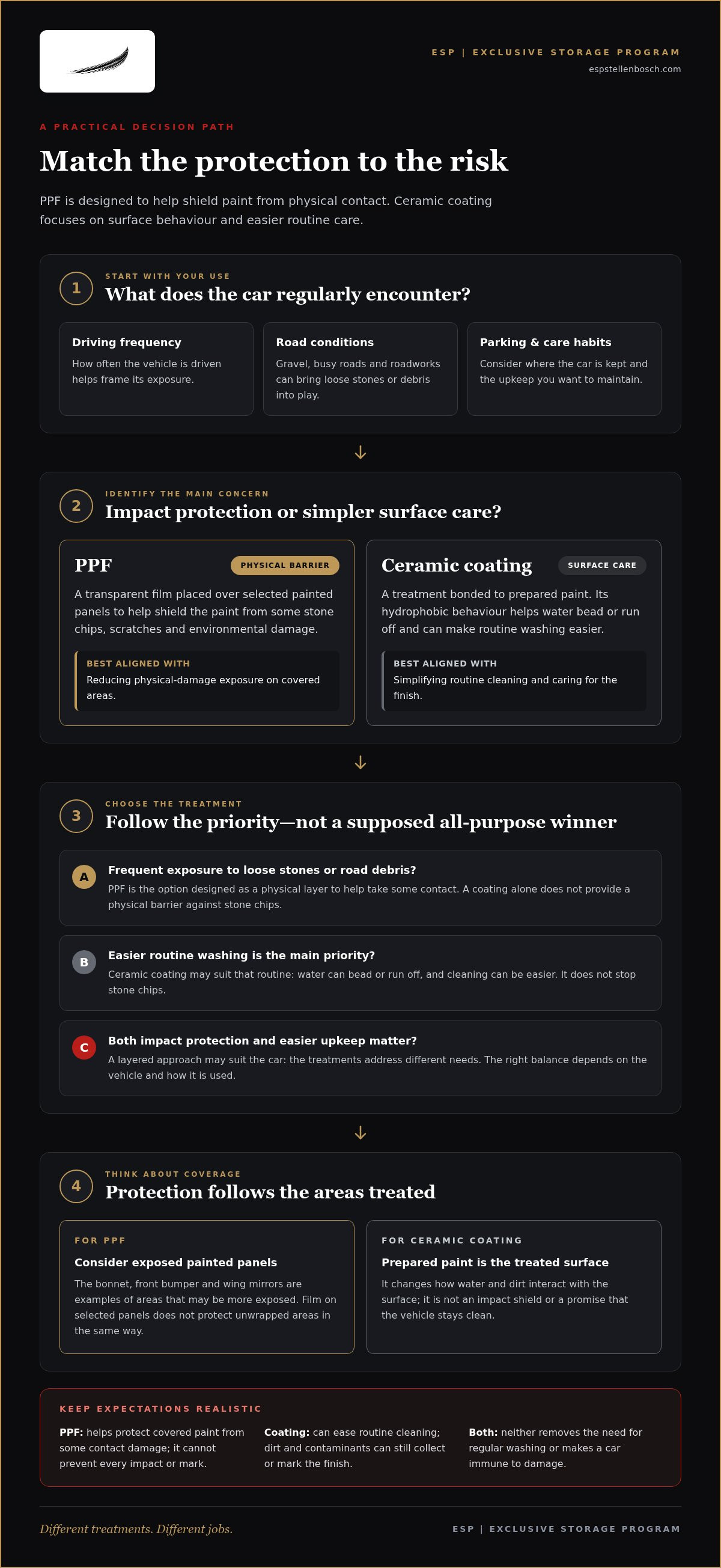
How to choose paint protection for your car and driving habits
A considered choice starts with the car’s real routine, not a blanket rule about which treatment is best. A vehicle driven daily on open roads may face different risks from one used occasionally and parked under cover. Use this framework to turn those details into a practical protection plan.
- Identify exposure. Consider how often you drive, the roads you travel and where the car is parked. Regular journeys on gravel or routes with loose debris may increase concern about stone chips. Outdoor parking can also mean more exposure to dust, bird droppings and other environmental contaminants. An occasional-use car still has exposure, but its pattern may be different.
- Prioritise protection. Decide what you most want to address: physical impact to painted panels, easier routine cleaning, or both. Ceramic coating can support surface care, but it doesn’t prevent stone chips. If chips are your concern, coating alone won’t provide the physical film barrier designed for that purpose.
- Select coverage. Think about which painted areas face the greatest exposure and whether targeted film coverage or broader coverage better suits your priorities. The choice affects which panels receive a physical barrier. Consider the appearance of film edges, too, and whether your preference is to focus on selected areas or protect more of the finish.
- Plan care. Match the treatment to the upkeep you’re prepared to maintain. A coating can support easier cleaning, but it doesn’t remove the need for washing and attention to the finish. If you’re considering film and coating together, plan the surface preparation and application sequence as part of one considered approach.
Start with the car’s condition and use
Before settling on a treatment, look closely at the paint as it is now. Existing marks, swirl patterns or oxidation can affect the finish you want to preserve. Paint correction may be relevant to the preparation plan, but protection shouldn’t be expected to conceal paint defects. ESP includes paint correction within its premium vehicle care, alongside ceramic coating.
Frequency is only one part of the picture. A car driven occasionally may still encounter loose stones on the roads it uses; a regularly driven car may spend much of its time in sheltered conditions. Parking, route and ownership priorities help make the choice more precise.
Make the plan fit your priorities
There’s no arbitrary vehicle-value threshold that determines the right answer. Instead, weigh how important impact protection is against your interest in easier surface care, then decide what coverage and ongoing attention feel appropriate. A combined approach can address both priorities, provided preparation and sequencing are planned for the chosen system.
For a tailored approach to your vehicle’s finish, explore ESP’s PPF and premium vehicle care.
ESP's approach to PPF and ceramic coating
The choice between PPF and ceramic coating is ultimately about what you want to preserve and how you use the car. ESP brings both forms of care into its work with luxury, performance and collector vehicles, while keeping their roles distinct. Professional PPF installation addresses physical exposure with film on selected painted areas. Ceramic coating, offered within premium vehicle care, serves a different surface-care priority.
That distinction allows the protection plan to follow the vehicle rather than a fixed formula. Consider the driving conditions, the panels most exposed, the finish’s current condition and the care routine you want to maintain. Those details help shape a more considered decision about film, coating or both.
Precision PPF installation for considered protection
ESP precision-installs self-healing PPF intended to help protect paint from stone chips, scratches and environmental damage. It offers a physical layer on the areas selected for coverage, making it relevant for owners who want to preserve vulnerable panels against road exposure.
Careful installation matters, particularly on the distinctive forms and finishes of luxury, performance and collector vehicles. Coverage can be considered in relation to how the car is driven and which areas face the greatest exposure. The film is not a promise that paint will remain untouched; it is a considered protective layer with a specific role.
Ceramic coating within a broader care approach
ESP’s premium vehicle care includes ceramic coating for owners whose priorities include surface care and routine upkeep. The coating has a different purpose from PPF, so choosing it should reflect what you want from the finish rather than an expectation that it will guard against every kind of damage.
Paint correction is also part of ESP’s premium vehicle care. It is a related service, not an automatic inclusion with ceramic coating. Considering the paint’s existing condition helps frame the preparation needed for the desired finish and protection plan.
For some owners, the focus will be physical coverage on selected panels. For others, coating may better align with their surface-care priorities. A combination can bring both roles into the plan, with preparation and application sequencing considered for the chosen approach.
ESP’s vehicle-protection care offers a considered starting point for preserving a car’s finish. Explore the options that best reflect your vehicle, its use and the level of care you wish to give it.
Give your car’s finish a considered next step
The most useful protection plan is one you can live with. It should reflect the way the car is used, the finish you want to preserve and the care you’re prepared to give it. Rather than treating protection as a permanent verdict, view it as part of thoughtful ownership. Before deciding, consider what would matter most to you over the coming years: fewer concerns about exposed paint, a simpler cleaning routine, or a balance of both. That priority gives your decision a clear measure beyond appearance alone.
For owners who value specialist attention, ESP brings professional PPF installation for luxury and collector vehicles together with premium vehicle care that includes ceramic coating and paint correction. The right approach depends on your car and its use. Explore ESP’s PPF and vehicle-care services to take a considered next step in caring for your finish.
Frequently Asked Questions
Can ceramic coating prevent stone chips?
No. Ceramic coating isn’t designed to absorb stone-chip impacts. If a vehicle regularly travels on loose-surfaced roads, PPF may be more relevant for the panels exposed to flying debris. The protection depends on where film is fitted and the force and nature of an impact. Areas without film remain uncovered, and severe contact can still cause damage even where film is present.
Is PPF or ceramic coating better for a new car?
Neither is automatically better for every new car. Consider how it will be used: will it be driven regularly on exposed routes, kept mainly in a garage, or used for occasional longer journeys? PPF may suit an owner focused on physical coverage, while coating may appeal if easier surface care is the priority. The PPF vs ceramic coating choice can also be tailored by panel, rather than treated as all or nothing.
Can ceramic coating be applied over PPF?
It may be possible to use ceramic coating as part of a layered approach, but the suitable products and application order depend on the film, coating and vehicle finish. The two treatments have different roles, so one shouldn’t be assumed to replace the other. ESP’s premium vehicle care includes ceramic coating, alongside professional PPF installation, allowing owners to consider a coordinated protection plan for their vehicle.
Does PPF change the appearance of a car’s paint?
PPF is designed to be transparent, but the result can vary with the film, paint condition, coverage and installation. For example, a change in surface texture or visible film edge may be more noticeable on certain panels or under particular lighting. Before installation, consider which areas will be covered and the appearance you want to retain. Existing marks beneath the film may remain visible.
Can PPF be applied to a car that has already been repainted?
Possibly, but the repaint’s condition and curing state need to be considered before film is applied. Paint systems and refinishing circumstances vary, so there isn’t a universal waiting period to rely on. If a panel has been resprayed, include that detail when planning professional protection. The finish can then be assessed as part of deciding how to prepare the vehicle and whether film application is appropriate.
Does ceramic coating make a car scratch-proof?
No. Ceramic coating doesn’t make paint immune to scratches or physical damage. It’s intended to influence surface behaviour, not act as an impact-absorbing layer. For instance, contact from a bag, brush or abrasive dirt during washing can still mark paint. If avoiding stone-chip damage is the main concern, consider PPF for selected exposed panels; choose coating for its distinct surface-care benefits.
Can you have PPF without ceramic coating?
Yes. PPF can be chosen on its own, with no ceramic coating added. This may suit an owner whose priority is a physical layer on selected panels and who doesn’t value coating’s surface-care role enough to include it. Film still needs attentive washing, particularly around covered areas. Think about the protection you want and the upkeep you’ll maintain, rather than assuming every vehicle requires both treatments.


