

PPF can reduce stone-chip damage, but it can’t prevent every chip. Thermoplastic urethane film is particularly effective on a vehicle’s front and can protect paint from most abrasions. It typically lasts 5 to 10 years, depending on film quality, installation expertise and vehicle maintenance.
It’s understandable to want a clear answer before choosing how to protect your paint. Paint protection film (PPF) can absorb impacts in a way wax and ceramic coatings cannot, but each option serves a different purpose and has its limits.
Learn where PPF offers the most useful defence, how it compares with wax and coatings, and which vulnerable areas merit attention. Stone chip protection for cars reduces the risk of damage; it does not make paint invulnerable.
Key Takeaways
- Prioritise the vehicle’s front, where road debris makes paint especially vulnerable, and consider which exposed areas matter most to preserve.
- Choose protection by its purpose: PPF helps absorb impact, whilst wax and ceramic coatings focus more on surface upkeep and resistance to dirt.
- Assess the paint’s condition before protecting it. Fresh paint may benefit from preservation, while worn-looking paint may need attention first.
- Think about finish as well as defence: installation quality plays a part in how clear and refined the protected paint looks.
- Set realistic expectations. PPF reduces the risk of stone-chip damage, but it cannot make paint invulnerable.
Recommended vehicle panels and vulnerable areas
Road debris first strikes forward-facing panels. At speed, stones and grit can chip clear coat, expose colour or leave abrasions. A supercar’s low nose sits close to the road, making the front bumper, bonnet and lower splitter natural priorities for PPF. Thermoplastic urethane film helps protect the front of a vehicle from stone chips.
Plan coverage around the car’s shape and use. Inspect the front bumper, bonnet edge, wing mirrors, front wings, side skirts and rear wheel arches. Mirrors and front wings meet airflow and debris, while side skirts and arches can collect grit thrown up by tyres. A PPF specialist can assess panel contours and seams when planning coverage.
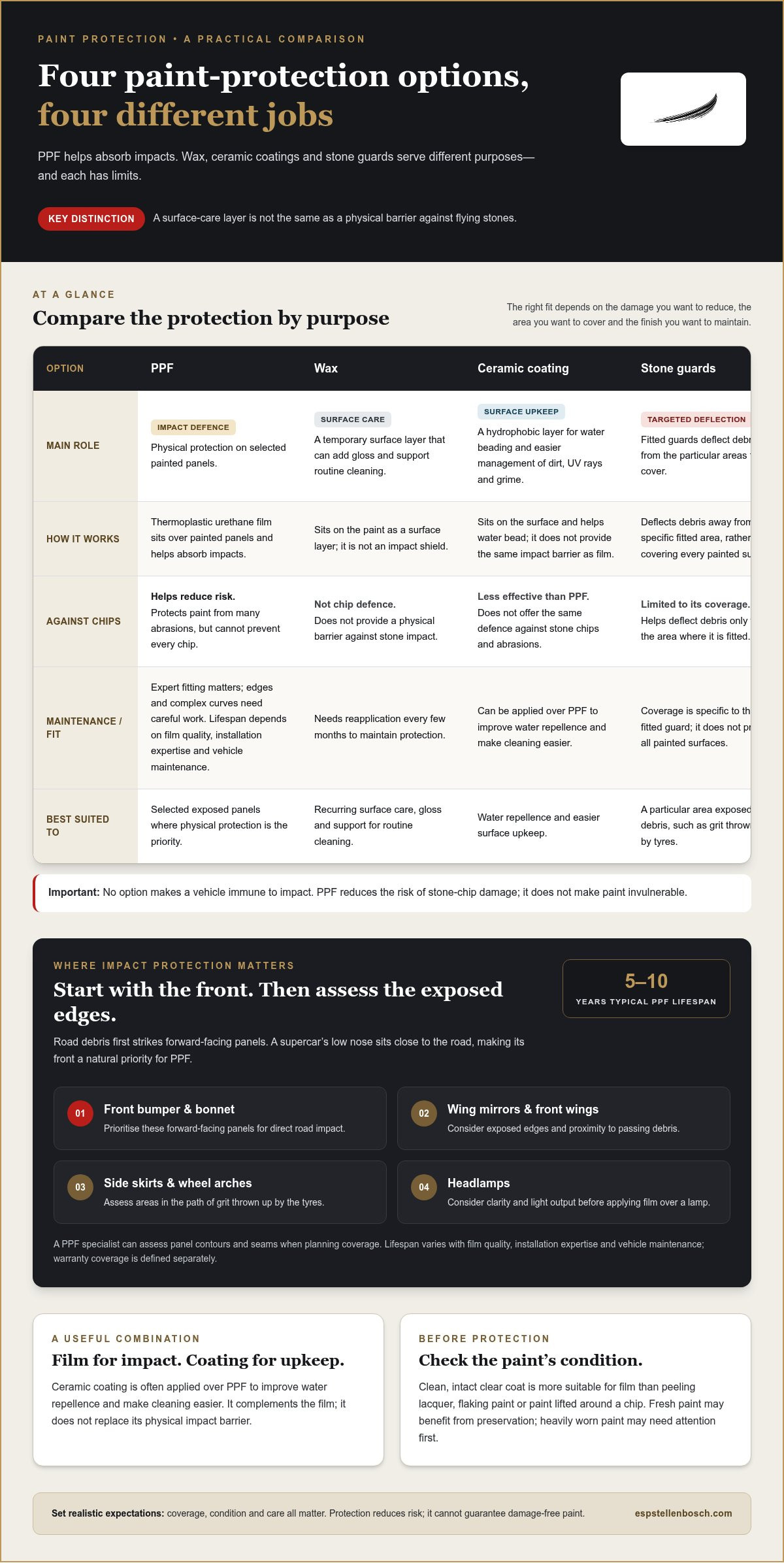
- Front bumper and bonnet: prioritise these forward-facing panels for direct road impact.
- Wing mirrors and front wings: consider their exposed edges and proximity to passing debris.
- Side skirts and wheel arches: assess areas in the path of grit thrown up by the tyres.
- Headlamps: consider clarity and light output before applying film over a lamp.
Consider the vehicle’s history. On a newer car with fresh paint, protecting exposed panels can help preserve their appearance. On a car with heavily worn paint, protection may be less worthwhile until the finish is restored. Paint condition, existing chips and how long you intend to keep the car all shape a sensible plan. Preserving original paint may support presentation at resale, but film cannot guarantee a higher resale value. Condition and documented care still matter.
A sprayable body sealant serves a different purpose from PPF. Applied over clean paint, it creates a surface layer that supports routine care, but it does not provide urethane film’s physical barrier against stone impact. Use sealant as a complementary finish-care step, not as a substitute for impact protection on the nose or bonnet.
PPF typically lasts 5 to 10 years, depending on film quality, installation expertise and vehicle maintenance. Warranty coverage is defined separately from lifespan, so review the terms that apply to the film and its installation.
For routine cleaning, rinse off loose grit before washing. Use a clean, soft wash mitt and automotive shampoo, work gently, rinse thoroughly and dry with a soft microfibre towel. Avoid rubbing debris across the film. Check its edges while washing and remove fresh contaminants promptly.
Useful care tools include a bright inspection light to reveal chips and lifted edges, a soft wash mitt for gentle cleaning, and a microfibre towel for drying with minimal rubbing. After washing, a spray bottle can help apply a suitable sealant evenly. Follow the product directions and avoid applying it to areas where it is not intended.
PPF compared with wax, ceramic coatings and guards
Choose protection based on the damage you want to reduce. PPF is a thermoplastic urethane barrier applied over painted panels. Its physical layer helps absorb impacts and protect paint from many abrasions. Wax and ceramic coatings sit on the surface but do not offer the same defence against flying stones. For a supercar driven on South African roads, that difference matters most on exposed paint.
Traditional car wax gives paint a temporary surface layer and needs reapplication every few months to maintain protection. It can add gloss and support routine cleaning, but it is not an impact shield. Ceramic coating creates a hydrophobic layer that helps water bead and makes dirt, UV rays and grime easier to manage. It is less effective than PPF against stone chips and abrasions. The two can work together: ceramic coating is often applied over PPF to improve water repellence and make cleaning easier.
- PPF: choose it for physical protection on selected painted panels.
- Wax: use it as a recurring surface-care step, rather than chip defence.
- Ceramic coating: consider it for hydrophobic behaviour and easier upkeep.
- Stone guards: use fitted guards to deflect debris from the particular areas they cover; they don’t protect every painted surface.
Guards and film serve different purposes. A guard deflects debris from a specific area, while PPF follows the surface of a chosen panel. Neither makes a vehicle immune to impact. Consider your routes, the panels exposed to tyre-thrown debris and the finish you want to preserve. A stone guard may suit one exposed area, while film can cover a broader painted section.
Each option has trade-offs. PPF is difficult to install, so expert fitting adds to the cost, and edges and complex curves need careful work. Wax needs regular renewal, while ceramic coating lacks film’s impact barrier. A guard helps only where it is fitted. These are practical limits, not reasons to expect one product to perform every role.
Useful care tools include a bright inspection light for spotting chips and film edges, a soft wash mitt for cleaning without dragging grit, and a microfibre towel for gentle drying. A spray bottle helps apply a compatible surface-care product evenly. Follow its directions, particularly when applying it over film or coating.
For a considered comparison of panel coverage and finish, explore professional PPF paint protection film as one option for your vehicle.
Factory paint compatibility
PPF is designed to sit over a vehicle’s painted surface, including sound factory paint. The finish’s quality and condition matter. Clean, intact clear coat is a more suitable surface than peeling lacquer, flaking paint or paint that has lifted around a chip. Inspect panels before installation, especially the bonnet, bumper and wing edges.
Factory paint can vary from panel to panel. A supercar may have complex curves, narrow panel gaps and delicate edges that require precise film placement. Repainted panels also need attention: previous paintwork may differ in preparation, adhesion and thickness. That does not automatically make film unsuitable, but the surface should be assessed before application. A visible repair on a front wing, for example, matters for both fitting and later removal.
A careful preparation sequence helps protect the finish beneath the film:
- Inspect: use a bright inspection light to find chips, scratches, lifting clear coat and previous repairs.
- Clean: remove road film, grit and residue so contamination isn’t trapped beneath the film.
- Assess: use a paint depth gauge as an inspection aid on panels with repair history.
- Fit: align film to the panel’s curves and edges without forcing it across sharp details.
Correctly installed PPF can be removed from sound factory paint without damaging the finish. Repainted, poorly bonded or failing paint carries a greater removal risk. Removal requires controlled warmth and a steady peel, rather than a sharp pull that stresses the surface. If film has become brittle or an edge catches, forcing it can lift vulnerable paint. Paint condition and the quality of earlier repairs are key considerations.
Removal also provides an opportunity to inspect the finish. As each section comes away, check for colour differences, old chips and adhesive residue before preparing the panel again. A soft microfibre cloth can lift remaining residue with a suitable adhesive remover. Avoid scraping with a metal blade, which can mark paint. A plastic trim tool can gently lift an accessible film edge, while an experienced installer can use a heat gun for controlled warming. Keep both tools moving and away from seals and trim.
For a previously repainted supercar, document visible repairs and paint condition before work begins. Photographs under consistent lighting help distinguish existing marks from later changes. On a car with original, well-maintained paint, the same inspection establishes a clear baseline. These steps make film application and future removal more considered, preserving the finish rather than treating every panel as identical.
Gloss and clarity
On a supercar, paint beneath a protected panel should still show its colour and reflections clearly. Clear thermoplastic urethane film is designed to sit over paint without hiding its finish. The result depends on the film, the condition of the paint beneath it and the precision of installation. Dust trapped under the film, a stretched edge or a poorly aligned seam can catch the eye across a glossy bonnet.
Inspect the finish before application. A bright inspection light makes swirls, sanding marks and old touch-ups easier to see. On a dark-coloured car, reflections can reveal subtle distortion; on a metallic finish, compare the panel in even daylight. Film does not correct paint defects. Addressing visible marks before fitting helps avoid sealing them beneath the surface.
Installation requires close attention to panel shape. A curved bumper or sculpted wing may need careful alignment, while edges and recesses call for clean, controlled placement. Review coverage boundaries on the car itself: a seam across a prominent bonnet may be more noticeable than one near a panel edge. The cutting and fitting method also affects how discreetly film follows each contour.
- Bright inspection light: reveals paint defects, trapped contamination and uneven film edges.
- Microfibre cloth: removes light dust during inspection without adding avoidable marks.
- Soft squeegee: helps an installer position film and move application solution from beneath it.
- Clean, shaded workspace: reduces dust settling on paint during preparation and fitting.
Some modern stone-chip films have a self-healing top coat. Minor scratches and swirl marks can repair when exposed to heat, helping the surface look tidier. This applies to minor marks, not deep cuts, impact damage or defects in the paint beneath the film. Set expectations according to the type of mark.
After fitting, inspect the car under consistent lighting. Compare both sides of the bonnet or front bumper, then look closely at film edges and curves. Slight visual differences may be easier to assess once the film has settled. Avoid picking at edges or polishing aggressively, as these actions can disturb the installation or create additional marks.
For routine care, rinse away grit before washing and use a clean wash mitt. Dry gently with microfibre, then review the finish in daylight. On a pearl-white supercar, for example, this check can help distinguish ordinary reflections from a mark that needs attention. Careful inspection and gentle washing help preserve clarity without treating the film as indestructible.
Protection from stone chips and road debris
PPF reduces the chance of stone chips reaching paint, but it cannot prevent every impact. Thermoplastic urethane forms a physical barrier over selected panels. On a supercar, the front bumper, bonnet and exposed lower surfaces often meet debris first. Loose stones can strike at speed, leaving chips, abrasions or marks through the clear coat. Film can absorb many impacts, but a sharp object or forceful strike may still damage the film or the paint beneath it.
In South Africa, the price depends on the vehicle, panel coverage, film and preparation, and is provided after a quote request. Complex curves, existing paint damage and the amount of film required affect the work involved.
Installation begins with inspecting and cleaning the paint, then accurately positioning film over the chosen panels. The installer removes application solution and works the film around curves and edges. Time depends on preparation, panel complexity and coverage. Protecting the front section involves less work than covering the full body. Consider the care taken during fitting and finishing, rather than choosing solely by speed.
South African motor insurance cover depends on the policy wording. Read the terms for paint damage and fitted protective film. Do not assume a stone-chip repair or film replacement is covered simply because the vehicle is insured.
For stone-chip protection in South Africa, look for specialist PPF installation with a clear panel map, careful paint preparation and written warranty terms. Review how sharp edges and complex curves are handled. Before work begins, go over the proposed coverage on the vehicle so you understand which painted areas are protected and where the film edges will sit.
Useful tools support the installation and inspection:
- Inspection light: reveals existing chips, scratches and contamination before fitting.
- Paint depth gauge: helps assess paint thickness, especially on repaired panels.
- Application squeegee: helps move solution from beneath the film during fitting.
- Microfibre cloth: removes residue gently during final inspection.
For rally cars, the Európai Unió notes that stone-chip protection may be omitted from lamps or headlamps if it significantly impairs their light. Clear visibility matters as much as protecting surrounding paint.
To discuss panel coverage for your vehicle, explore PPF Paint Protection Film.
ESP | Exclusive Storage Program: PPF Paint Protection Film
ESP | Exclusive Storage Program offers PPF Paint Protection Film for owners seeking a physical layer over vulnerable painted panels. If you’re weighing protection for a supercar’s front end, the next step is considering which areas matter most and how film fits your care routine. PPF can reduce stone-chip damage, while careful panel preparation and installation support a refined finish.
Turn to ESP when you are ready to discuss PPF for your vehicle. Suitable coverage depends on the panels you want to preserve and the car’s existing paint condition. It is a considered part of ongoing vehicle care, not a promise that paint will remain untouched by every impact.
For a conversation about PPF Paint Protection Film, visit espstellenbosch.com.
Choose a protection plan that suits your next drive
The right choice depends on how you use and care for your car. Consider which panels you want to preserve, how often the vehicle travels on open roads and how you want its finish to look over time. This makes stone chip protection for cars a considered part of ownership, rather than a reflexive add-on. PPF can reduce impact damage, but no film can make paint immune to every stone or piece of road debris.
For a joined-up approach to vehicle preservation, ESP | Exclusive Storage Program offers PPF alongside Secure Indoor Storage and Drivers Club. These services support different needs, from protecting selected paintwork to caring for a vehicle between drives and connecting with fellow enthusiasts.
If you’re ready to discuss a suitable next step for your vehicle, contact ESP | Exclusive Storage Program. A thoughtful protection plan can help you enjoy the drive while giving the finish attentive care.
Frequently Asked Questions
Can PPF prevent all stone chips?
No. PPF reduces the chance of chips reaching the paint, but a forceful impact or sharp debris can still damage the film or the surface beneath it. Treat it as a sacrificial layer, not an invulnerable shell. If a stone leaves a mark, inspect the film promptly. A small puncture or lifted edge can affect how well that section continues to protect the panel.
Is stone chip protection film noticeable once installed?
Clear film is intended to preserve the paint’s visible appearance, though it may be noticeable at close range. Look for edges, joins and areas where film follows a tight curve, such as a bumper corner. Bright lighting on a dark car can make surface marks or installation lines easier to see. Before fitting, review the planned coverage on the vehicle and consider where panel edges will fall.
What is stone chip protection for cars and how does it work?
Stone chip protection for cars is a protective layer applied to selected painted surfaces to reduce damage from road debris. PPF uses thermoplastic urethane between the paint and incoming grit or stones. If debris strikes a covered panel, the film takes the impact first. Coverage is selected by panel, so protection can be applied to specific areas rather than every painted surface.
What types of car stone chip protection are available in South Africa?
Options include PPF, traditional wax, ceramic coatings, fitted stone guards and sprayable body sealants. They serve different purposes. Film provides a physical layer over chosen paintwork; wax and coatings support surface care, while guards deflect debris locally. Sealant adds a surface layer but is not an impact barrier. Panel-specific film may suit a car used mainly on paved routes differently from one driven on gravel.
How does paint protection film compare with ceramic coating and spray-on protection for stone chips?
PPF is designed to absorb impacts over covered panels, so it offers more stone-chip defence than ceramic coating. Ceramic coating creates a hydrophobic surface that helps water and grime release more readily, but it does not match film’s physical barrier. Spray-on sealants support surface care rather than impact protection. For a combined approach, ceramic coating can be applied over PPF to aid cleaning.
Which car panels should be covered with stone chip protection?
Start with painted panels exposed to forward-moving debris: the front bumper, bonnet and leading edges of the front wings. Then consider wing mirrors, side skirts and areas around the wheel arches, where passing traffic or tyres can throw up grit. A car driven regularly on gravel may call for broader coverage than one used mainly for short urban journeys. Keep headlamps clear if film could affect their light output.
How long does paint protection film last and what warranty does it include?
Paint protection film typically lasts 5 to 10 years, depending on film quality, installation expertise and vehicle maintenance. Warranty coverage is separate from lifespan, so check the terms for the film and its installation.


