

A vehicle’s price tag doesn’t decide whether membership makes sense. Luxury car membership in South Africa can suit premium vehicles above or below R1 million, depending on the experience and care an owner values. The scene has a club heritage too: IBV Supercar Club’s Guinness World Record event took place on 21 September 2014.
When considering luxury car membership in South Africa, it’s natural to look beyond the car itself. The quality of the ownership experience, the care a vehicle receives and the opportunity to connect with other enthusiasts all shape what membership can offer.
Premium memberships can combine practical vehicle care with community and concierge support. The right fit depends on whether you want access to a vehicle, help managing one you own, or a club experience that brings enthusiasts together.
Key Takeaways
- Explore how South Africa’s luxury car clubs shape the ownership experience, beyond the vehicle itself.
- Assess membership eligibility and application steps before deciding whether a club suits your needs.
- Compare mileage, insurance excesses and usage terms carefully, as these can shape the value of membership.
- Weigh membership against leasing, renting or buying, then consider how paint protection can support vehicle care.
What luxury car membership clubs operate in South Africa?
IBV Supercar Club is a named example of South African motoring-club culture. Its charity parade was accompanied by 5 helicopters, a striking illustration of the spectacle around supercar enthusiasm. That event alone doesn’t establish what members receive. For luxury car membership in South Africa, distinguish an enthusiast club from a vehicle-access programme or a dealership’s ownership experience.
Start by identifying each programme’s purpose. A motoring club may focus on shared interests and events, while a vehicle-access programme centres on using cars. A dealership experience relates to buying a vehicle and the services around ownership. These categories can overlap, so look beyond the name and read what the membership actually includes.
Compare each organisation’s stated membership benefits. Note whether it offers vehicle access, community activities or services for vehicles members own. An event such as IBV Supercar Club’s parade shows that a public event took place, but it does not establish that every membership includes event participation or vehicle use.
- Club identity: note whether the emphasis is shared motoring interest, vehicle access, or both.
- Vehicle terms: distinguish access to a car from ownership of the car.
- Dealership role: identify which parts relate to buying and owning a vehicle.
- Member experience: treat a documented event, such as IBV’s parade, as an example rather than a standing benefit.
This comparison helps owners of premium vehicles above or below R1 million focus on the experience, not just the price bracket. Consider whether your priority is driving, community, dealership support, or care for a vehicle you already own. Each represents a different kind of membership or ownership relationship. A club’s public profile may introduce its character; its stated terms explain what participation involves. Use those details to decide which type of programme best aligns with your expectations before comparing individual membership options.
What are the membership eligibility requirements and application steps?
There is no single eligibility standard for every motoring club in South Africa. Each sets its own application process and membership terms. Separate clear requirements from general descriptions of the experience. A community-focused club, for example, may assess applicants differently from a programme that provides access to vehicles.
Begin with the written criteria. Look for any stated vehicle, ownership or conduct conditions, and whether membership is open to individuals or linked to a particular car. Don’t assume that owning a premium vehicle automatically qualifies you. The programme’s rules determine eligibility.
Use this sequence to assess an application:
- Read the entry criteria. Note each condition the club names, including any vehicle or applicant requirements.
- Match your circumstances. Compare your intended use and vehicle ownership with those criteria.
- Review the membership terms. Identify what participation includes, what obligations apply and how the membership operates.
- Submit the application. Follow the club’s stated process and provide the details it requests.
Keep the decision focused on practical fit. An owner considering a car above or below R1 million should still examine the same essentials: who may apply, what the membership is designed to provide, and what responsibilities accompany it. Vehicle value alone doesn’t explain whether a particular club suits an applicant.
Before committing, compare the requirements and terms for each option. Note whether it centres on club participation, vehicle access or support for vehicle ownership. This helps avoid a mismatch, such as choosing a community membership when you mainly want access to a car, or expecting vehicle access from a programme focused on participation. Reading the criteria first makes the next step clearer.
What mileage limits, insurance excesses, and usage restrictions apply?
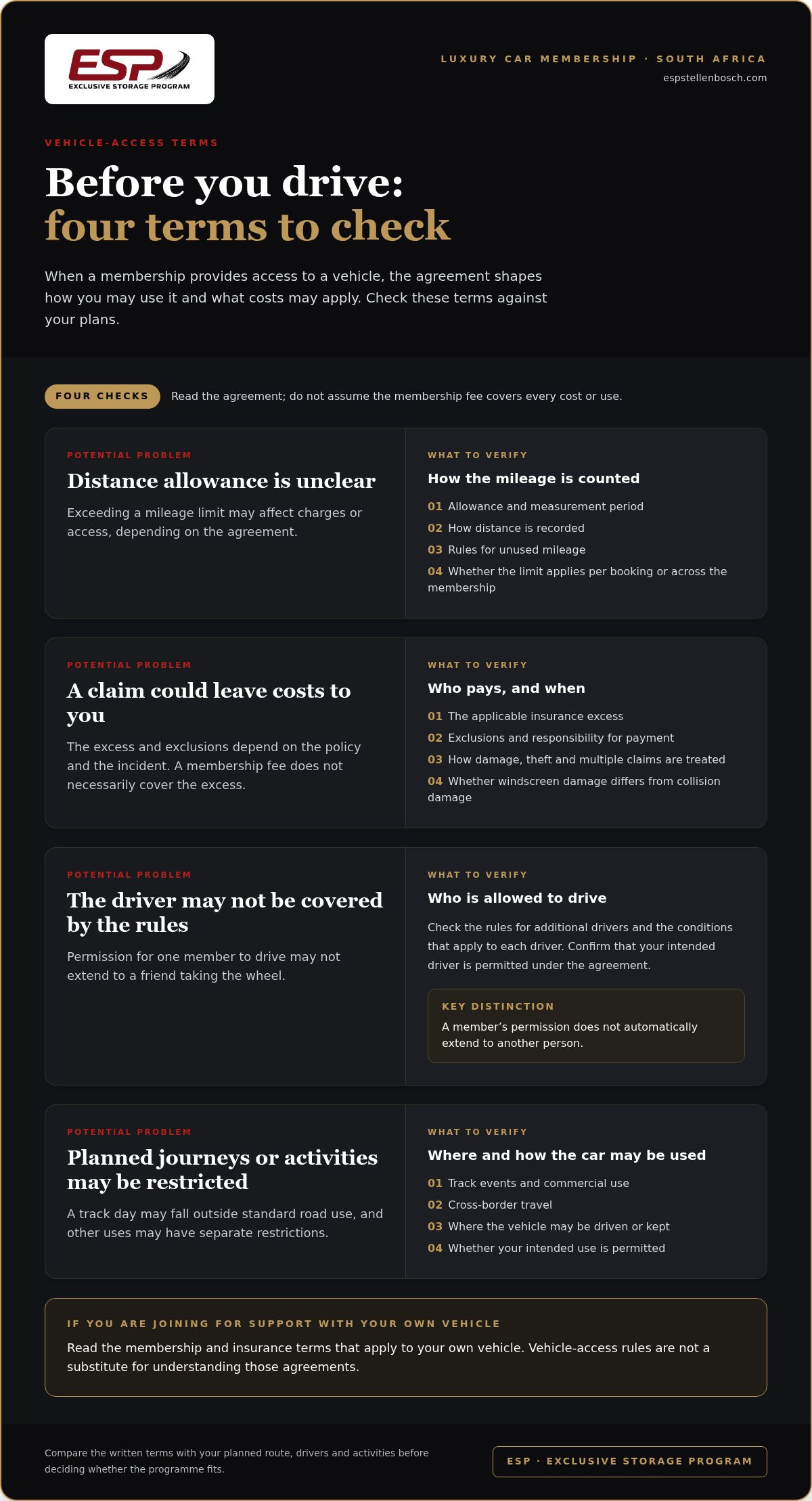
If a programme provides vehicle access, its terms determine how you may drive and what costs may apply after an incident. Check the mileage allowance, insurance excess and permitted uses. If you are joining a club for support with your own vehicle, read the relevant membership and insurance terms instead. Membership does not replace the need to understand the agreements that apply.
For vehicle-access programmes, a mileage limit sets the distance allowed during a booking or stated period. Depending on the agreement, exceeding it may affect charges or access. Compare your planned route with the allowance and check how distance is recorded. Also look for rules on unused mileage and whether the limit applies per booking or across the membership.
An insurance excess is the amount the insured person pays towards a claim. How much applies depends on the policy and the incident. Check how the agreement treats damage, theft, multiple claims and exclusions. For example, find out whether windscreen damage is handled differently from collision damage. Don’t assume a membership fee covers the excess.
For a vehicle-access programme, usage restrictions can affect everyday plans. Review rules for additional drivers, track events, commercial use, cross-border travel and where the vehicle may be driven or kept. Permission for one member, for example, may not extend to a friend taking the wheel. A track day may also fall outside standard road use.
- Distance: find the allowance, measurement period and consequence of exceeding it.
- Claims: identify the excess, exclusions and who is responsible for payment.
- Drivers: establish who may drive and what conditions apply to each driver.
- Use: compare your intended journeys and activities with the stated restrictions.
Match the terms to how you plan to use the programme. Someone arranging occasional local drives has different needs from someone planning frequent long-distance journeys. Compare the allowance, excess and restrictions side by side to see the practical trade-offs, rather than relying on a headline benefit.
How does luxury car membership compare with leasing, renting, or buying
Choose between membership, leasing, renting and buying by considering how much access, control and responsibility you want. In South Africa, the right fit depends on how often you drive, whether you need a particular vehicle and how much of its care you want to manage.
Membership can centre on shared motoring experiences, vehicle access, or services defined by its terms. It may suit someone seeking variety or a club connection without purchasing every vehicle they drive. Read the agreement for access conditions, usage limits and insurance responsibilities. Membership doesn’t automatically mean unrestricted access or ownership.
Leasing provides use of a specified vehicle under an agreement, while ownership remains separate. It may suit you if you want consistent access to one car without buying it outright. Compare the commitment period, permitted use, care obligations and return conditions to see whether the arrangement fits your needs.
Renting suits a defined period or occasion. A weekend drive in a premium model, for example, can meet a short-term need without a long-term ownership commitment. Before setting out, check the rental agreement for driver rules, distance conditions, insurance excess and return requirements.
Buying gives you ownership and greater control over how you use the vehicle. It also makes you responsible for ongoing care and eventual resale. Buying can suit you if you want the same car for regular journeys and value keeping it over time.
- Want variety or community? Compare membership purpose and access terms.
- Want one vehicle for an agreed period? Examine leasing commitments and return conditions.
- Need a car for a specific occasion? Consider rental terms and permitted use.
- Want lasting control? Weigh buying against ongoing ownership responsibilities.
Compare the written terms against your actual driving pattern, not just the vehicle’s value. For a membership-led approach, explore Signature Membership as one option to consider.
ESP | Exclusive Storage Program: PPF Paint Protection Film
ESP | Exclusive Storage Program offers PPF Paint Protection Film for owners who want an added protective layer for their vehicle’s paintwork. It’s a practical consideration for a premium car you plan to keep and care for, whether its value sits above or below R1 million.
If you own a vehicle and want support with its care, storage or community connections, ESP’s Secure Indoor Storage, Premium Vehicle Care, Drivers Club and Signature Membership address different needs. Choose based on what matters most, whether that’s protecting the vehicle, keeping it stored securely or joining a motoring community.
Contact ESP | Exclusive Storage Program to discuss PPF Paint Protection Film and the vehicle care that suits your priorities.
Shape an ownership experience that suits you
The right membership is personal. Decide what you want from your relationship with your vehicle: more community, dedicated care or simpler day-to-day management. For anyone considering luxury car membership in South Africa, this can guide the next conversation more clearly than a badge or price bracket.
ESP | Exclusive Storage Program brings together PPF Paint Protection Film, Secure Indoor Storage and Drivers Club membership. These options support different parts of ownership, from caring for paintwork to keeping a vehicle securely stored or connecting with other enthusiasts. Consider your main priority, then explore how it fits your plans.
Contact ESP | Exclusive Storage Program to discuss a considered next step for your vehicle. The right approach starts with what matters to you.
Frequently Asked Questions
What cars are included in South African luxury car membership programmes?
Membership programmes in South Africa do not all provide a fleet of cars. Some focus instead on community and care for vehicles their members own. ESP’s Signature Membership brings together storage, vehicle care, community and concierge support. It is designed around members’ own vehicles, so consider whether you want support with ownership or a programme that provides a vehicle to drive.
How do luxury car memberships work in South Africa?
A luxury car membership in South Africa provides the benefits set out in its terms. ESP’s Signature Membership includes Secure Indoor Storage, Battery Management, Tyre Pressure Monitoring, Monthly Premium Detail, Members Lounge access, Drivers Club access, Priority Booking and Concierge Support. Compare these features with your vehicle and ownership needs to decide whether the membership is right for you.


